Strategy and System Design Case Study
Protecting $500K to $2M enterprise deals
by translating AI governance into buyer-ready proof
Qlarc is a workflow that turns the governance AI vendors already have into proof enterprise buyers can evaluate.
Qlarc was a five-person team.
Qlarc
Enterprise AI deals stall in governance review. Assembling a credible evidence pack takes teams 15 to 20 days of cross-team scramble per deal, and it stalls $500K to $2M deals.
Designed and built the system architecture and financial model, tested the extraction pipeline against real governance documents, then led product design (five-person team).
A workflow that maps the evidence vendors already have to the questions buyers ask, keeps a hard boundary between what the model reads and what it cites, and locks export behind a named human.
Usability testing put evidence-pack prep down 60 to 80% against assembling one by hand. I tested the extraction pipeline separately, on 8 documents, 3 real and 5 built to break it: 0 fabricated claims across 280 evidence checks.
Turn the governance vendors already have into proof a buyer can evaluate.
The design thesis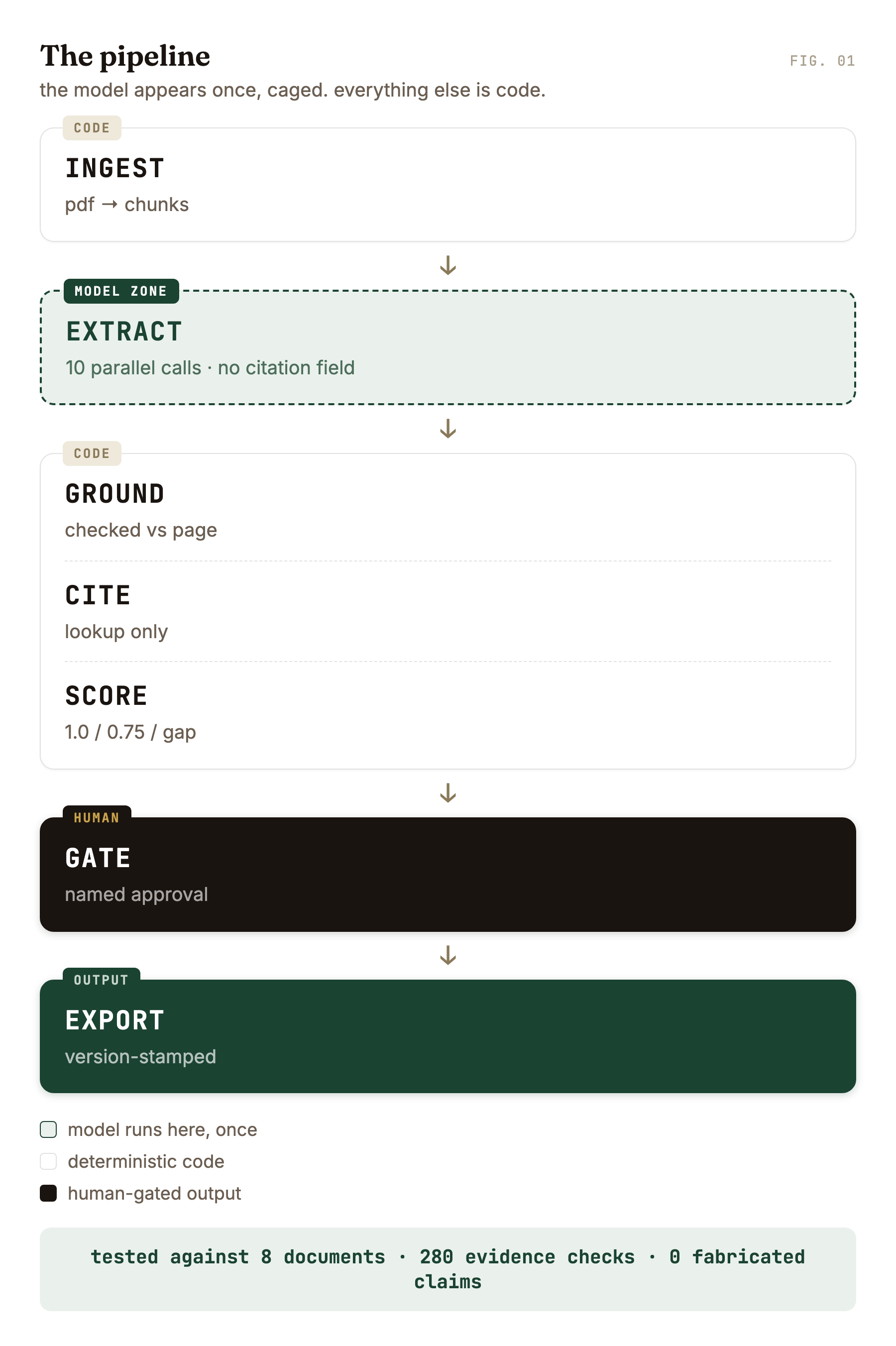
The governance exists.
It just cannot be translated.
AI-enabled vendors have real governance work. Real people wrote it. Real teams signed off on it. But it lives scattered across the organization and none of it is in the format enterprise procurement legally requires or can evaluate.
- EngineeringUNTAGGED
- LegalUNTAGGED
- ComplianceUNTAGGED
- SecurityUNTAGGED
Several teams hold the proof. None of it is tagged or in a form a buyer can read.
One structured document. Every claim at the clause level. Incomplete submissions are discarded, not reviewed.
The governance exists on the left. The buyer requires the right. Nothing converts between them.
The cost?
The vendor submits what they have. The buyer’s AI Ops team marks it incomplete.
They do not follow up.
Buyers built systems to ask.
Vendors never built systems to answer.
i kept trying to design a better governance tool, and it kept feeling redundant, the vendors already had governance. took me a while to admit i was solving the wrong half. the gap wasn't missing rules, it was that one side spent ten years building systems to ask and the other side had nothing to answer with. the moment i stopped adding governance and started translating it, the whole thing clicked.
Validated the problem from the people who enforce it, feel it and advise on it.
Validated across three named experts in two research phases, early-stage discovery and a March 2026 follow-up. Each conversation shaped a specific product decision below.
Pratik Patel
Procurement stops are hard blocks, not delays. Unclear answers end evaluation, buyers do not follow up.”
Dr. Cari Miller
Proactive, candid vendors win. Evasive ones do not, regardless of product quality.”
Debashis Bhattacharyya
Documentation gets rebuilt from scratch every cycle. Sales teams cannot answer technical AI questions.”
Qlarc turns scattered governance into structured proof.
A vendor-side platform for AI-enabled FinTech companies preparing for enterprise procurement review. It takes the evidence a vendor already has and structures it into a package a buyer can actually evaluate.
Assess readiness, connect AI metadata, and upload the governance evidence that already exists.
Map evidence to procurement questions, then fill only the gaps.
A named human signs off on every claim before anything ships.
Human gateExport one verifiable evidence pack, ready for the buyer.
65% of your Evidence Pack already built. Not created from scratch. Found.
Illustrative example, not a measured result.
the tempting version of this product just writes the answers for you. i killed that on purpose. the second a tool invents a compliance claim it's not a feature, it's a liability. so every claim routes through a named human before anything ships, the AI maps and drafts, but a person still signs their name to it. “translates, doesn't invent” isn't a tagline here, it's the whole product decision.
The hard part was knowing what to refuse.
Three decisions. Two hard boundaries. One pipeline. The structure is a direct response to the strategic bet, and each boundary exists because a specific failure mode in regulated FS procurement made it necessary.
04 · Verification · Trust is claimed until it's tested
An unverified safeguard is a hope, not an architecture. The claim that the model cannot fabricate a citation is only true if something has tried to break it and failed.
Before this system ever touched a real document, I hand-labeled the correct answer for 10 test documents myself (the gold set), then ran the system against them and checked every answer against what I'd already written down (the eval), once, before anything shipped.
The system read this document and found a real claim. It also found a second real claim it couldn't fully verify. Rather than guess, it dropped it. A system willing to lose a true claim rather than risk a false one is the only kind a bank can actually rely on.
Result· What the four decisions produce: documentation that survives review because every claim is sourced, every citation is verified, every input is tiered by trust, and the boundary that prevents fabrication has been tested against real documents built to defeat it, not just asserted.
I chose trust over automation.
The fastest answer was not the best answer.
The most trustworthy answer was.
Why the pricing works.
Set the deal and the tier. One recovered deal covers the year. Then stress-test the math with your own assumptions.
One recovered $800K block pays for the $25K Scale tier for the year, many times over.
This is a sensitivity check, not an outcome. What a pilot actually tests is whether vendors convert at the rates the model assumes.
And before a single recovered deal is counted, the manual coordination Qlarc replaces runs $25K to $40K a year in senior staff time. The operational case stands on its own.
AI does the work.
I do the thinking.
Research, synthesis, iteration · Speed and scale
Strategic framing · Regulatory accuracy · Defining what the product is
Qlarc is a compliance platform that helps vendors demonstrate regulatory adherence.
Vendors already have governance. This is an evidence translation engine, not a compliance tool.
New GTM, new positioning, new competitive set. One reframe changed everything downstream.
Vendors face procurement delays of 15 to 20 days when governance documentation is incomplete.
This is a hard stop, not a delay. Buyers mark submissions incomplete and close the evaluation.
The entire revenue-loss argument depends on this single distinction. A delay is recoverable. A hard stop is not.
The next version would need to prove trust inside live procurement cycles.
Will vendors pay for this?
The problem is validated. Demand is not. Three experts confirmed the pain is real, but none was asked whether they would buy.
Pilot pricing with vendors in active procurement to test conversion at $15K to $25K.
I set out to help honest vendors prove they’re trustworthy. The risk I never closed is that the same tool helps any vendor look the part.
Qlarc packages the governance a vendor already has into proof a buyer will accept. The hardest decision wasn’t what to build, it was how to build it so it could be reused, and that’s the catch: the clean, repeatable format that helps an honest vendor read as ready helps a careless one just as well. Source-attribution and the human gate stop it from inventing evidence, not from making thin governance read as strong. Whether Qlarc raises the floor on trust or just raises the polish is the line I’m least sure I stayed on the right side of.
the honest version: i built this to get good vendors past a broken process. the same tool gets a careless one past it just as fast.
source-attribution and the gate are my answer. i still can’t tell if a clean pack proves good governance, or just good packaging.