Leadership Transparency Index · 2026

Who holds power is public information. Nobody could read it.

So I built the instrument that does, a diagnostic that turns scattered governance filings into a tier-by-tier map of where authority narrows.

I designed
Framework, choke-point metric, data-classification system, business model
Goal
Turn public governance filings into a readable, comparable map of where leadership power narrows
01The problem

Power concentrates as hierarchies compress. The filings never showed where.

The industry pattern is no secret, McKinsey publishes the funnel every year. What did not exist was a way to read it per company, from each firm’s own filings, tier by tier, and put two firms on the same scale. Governance data is public; comparable governance data was not.

That is a data infrastructure problem. So I built the diagnostic.

02The contribution

What I synthesized and what I invented are not the same thing.

I synthesized three structural forces from existing research, political gatekeeping, economic reward structures, and social perception bias (McKinsey, MIT Sloan, Stanford GSB), into a model of how authority filters upward. The synthesis is borrowed. The choke-point ratio is the contribution.

1:X

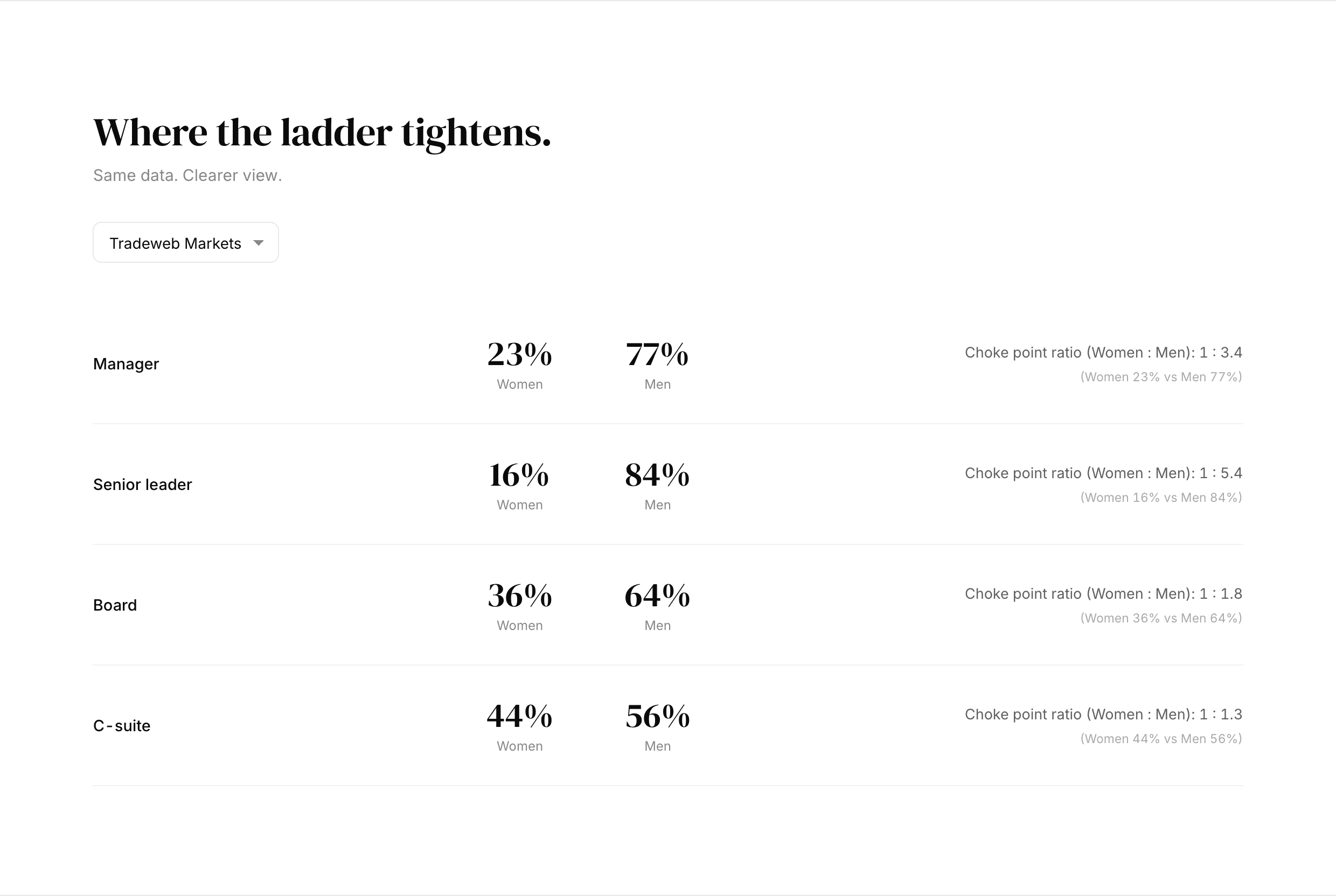
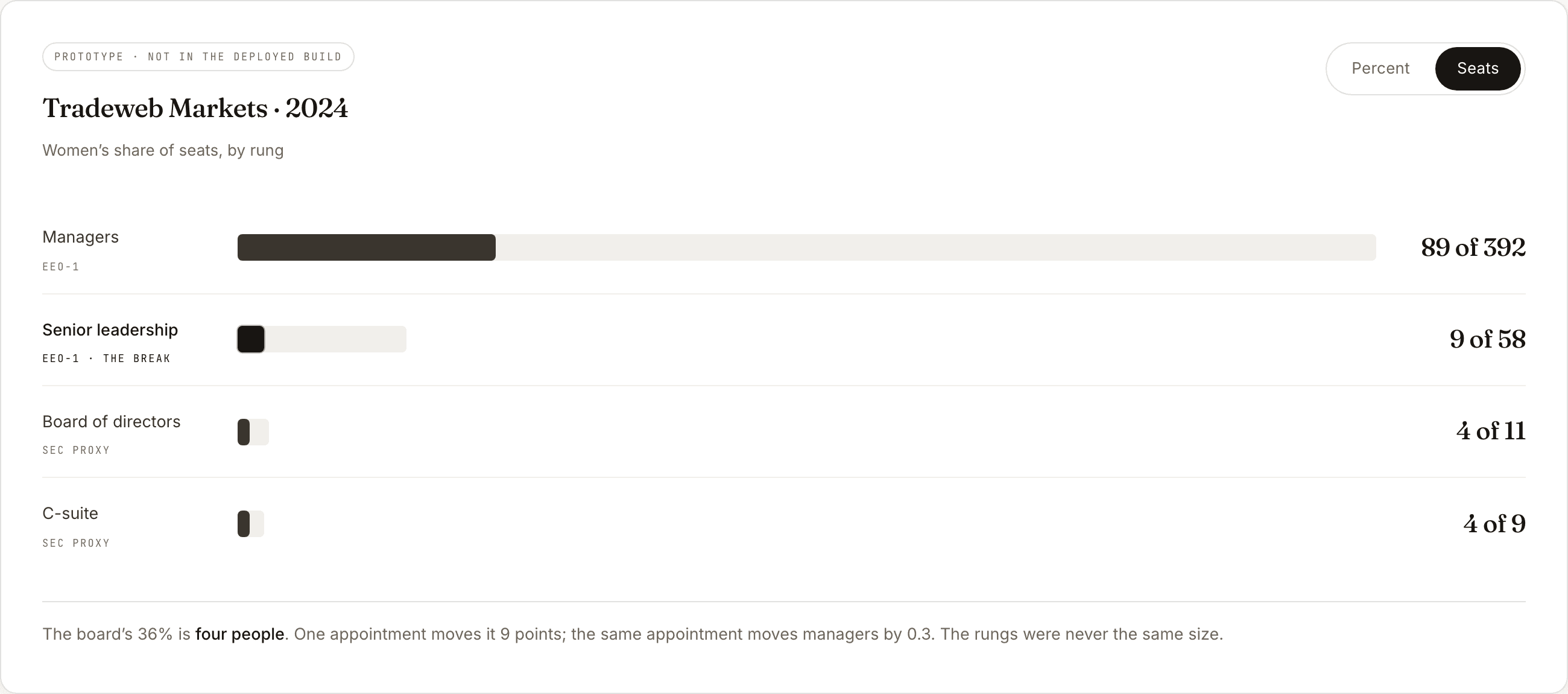
The choke-point ratio. At each tier, for every woman at a given level, how many men. Calculated tier by tier, never in aggregate, because the aggregate hides the one step where the ladder narrows hardest.

Rejected
Aggregate representation score

Cannot isolate the bottleneck. Two firms with identical scores can have completely different tier profiles. The score hides the signal.

Rejected
Composite governance index

Easier to compare, too easy to game. A composite number hides which tier is the problem.

Chosen
The choke-point ratio

Tier-specific, transparent, reproducible, comparable within a sector. One precise question per tier, answered the same way every time.

03How it's calculated

Nothing here is private. The index only reads what companies already file.

Every input is public and verifiable, no surveys, no internal access. Four steps turn two filings into one comparable ladder, then find where it breaks.

01

Collect

Two public filings.

  • SEC proxy statementBoard and executives, by name
  • EEO-1 reportLeadership counts, by job category
02

Normalize

Into one four-rung ladder.

  • Boardproxy
  • C-suiteproxy
  • Senior LeadershipEEO-1
  • ManagersEEO-1
03

Classify

Conservatively, and flagged.

  • Aggregates labeled, never read as individuals
  • Unverifiable gender flagged uncertain
  • Every figure traceable to its filing
04

Compute

One ratio, one signal.

  • women : men, per rung
  • steepest fall = the choke point
04 · The proof

Same sector. Same rules. Two different power structures.

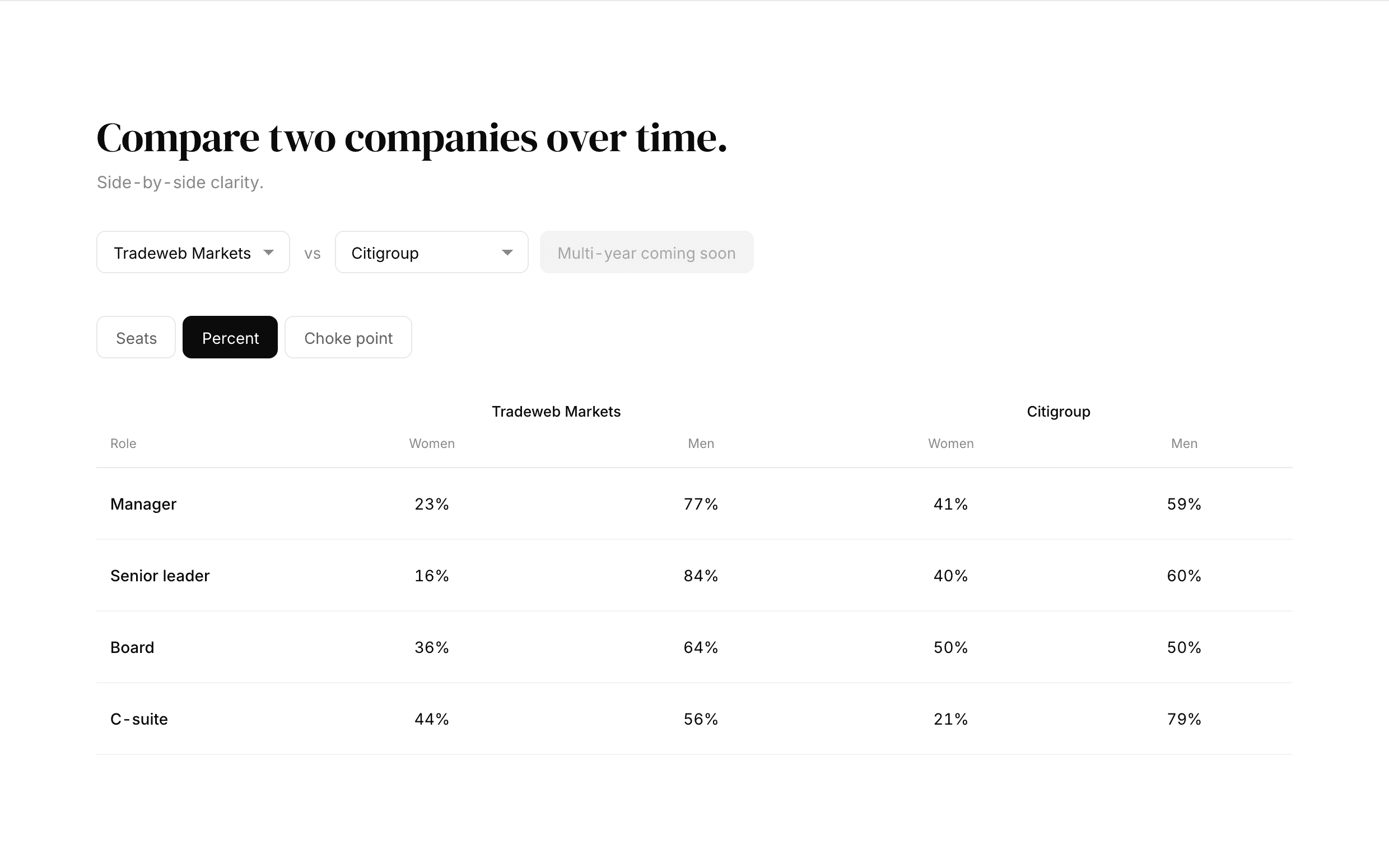
The pilot indexes Tradeweb Markets and Citigroup from real SEC and EEO-1 filings. I chose financial services deliberately, same sector, same regulator, same talent pipeline. Any difference at the same tier is structural, not contextual.

whodecidespower.lovable.app/#compareOpen ↗

Live from the build. Switch the companies, or toggle Seats / Percent / Choke point.

3.6×

At the senior-leader tier, Tradeweb chokes women out 3.6 times harder than Citigroup, 16% of the seats versus 40%, in the same industry under the same regulator. Both numbers are live in the comparison above.

Embedded live from whodecidespower.lovable.app. The build also adds multi-year tracking and a 41-second silent concept film for LinkedIn.

05Where it goes

A diagnostic now. A certification at scale.

The diagnostic shows a company its own power structure. The endpoint holds it to that structure, the same logic as B-Corp, applied to how decision-making authority is distributed.

Phase 01 · Now
Diagnostic mirror

It shows a company its own power structure, tier by tier, from data that is already public.

01Tier-by-tier power profiles from public data
02Choke-point ratio per tier, where authority narrows sharpest
03Trajectory: improving, flat, or declining
04Cross-company comparison within a peer sector
Profiles, not rankings · Ratios, not scores · Explicit uncertainty
Phase 02 · At scale
Fair Leadership Certification
A standard a company can be measured against, not a cleaner way to deny the gap.
Voluntary, audit-based, binary, public. Certified for structural defensibility, never numerical parity.
01Two audit tracks: merit progression and structural access
02Industry frameworks across finance, tech, and healthcare
The index becomes the standard

Public data reveals the power structure.

Paid services help the organization act.

Verification builds trust.

Certification proves defensibility.

06 / What I'd prove nextAn honest note

The method is built to run on fifty companies. So far I have run it on two.

Two firms in the same sector is a prototype, not proof. It shows the index can read a real power structure straight from public filings, but a single dramatic ratio carries more weight than a sample of two can hold. The honest next step is the unglamorous one: run it across the fifty firms it was scoped for, and put the headcounts and the uncertainty on screen, even on the cycles where that makes the story quieter.

Margin note · to self

two companies is a demo, not a finding. state the counts. show the error bars. even when they make it less impressive.

the version i actually trust is the one running on fifty.

Next case study

United Healthcare.

StrategyAI GovernanceHealthcare

AI could process millions of claims. Nobody built accountability for what those claims decided.

LTI · Leadership Transparency Index · 2026WIN Challenge · Pratt MPS Design Management